

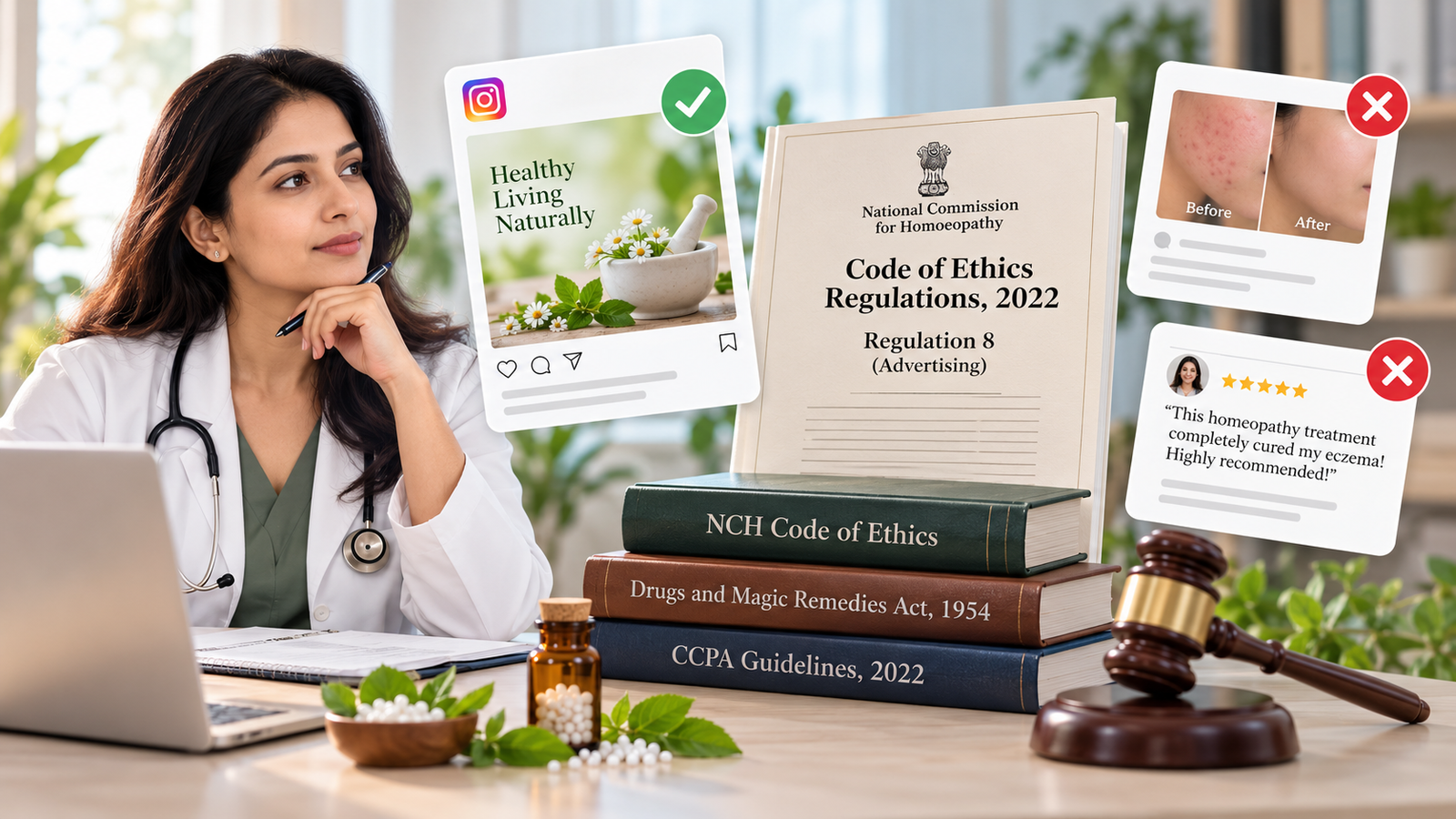
Most homeopaths in India now have an Instagram page, a Google Business listing or a WhatsApp broadcast list. Very few have read the regulation that decides what they may post on them.
That regulation is Regulation 8 of the National Commission for Homoeopathy (Professional Conduct, Etiquette and Code of Ethics for Practitioners of Homoeopathy) Regulations, 2022, notified on 13 December 2022. It replaced the 1982 Code. Breaching it is professional misconduct, which State Councils and the NCH’s Board of Ethics and Registration can act on.
This guide explains what the Code says, which other laws sit on top of it, and how to read them for everyday posting. It is general information, not legal advice.
The core rule: no solicitation, no self-promotion
Regulation 8(1) says that soliciting patients, directly or indirectly, through newspaper ads, placards, circulars or handbills is unethical.
Regulation 8(2) goes further. A practitioner may not use, or let others use, their name or signature in publicity through “lay channels” that draws attention to their professional position or skill, or results in self-aggrandisement.
What you are explicitly allowed to announce
The proviso to Regulation 8(2) permits a formal announcement in media about six things only:
- Starting a practice
- A change of address
- Temporary absence from duty
- Resuming practice
- Succeeding to another practitioner’s practice
- Registration on an Ayushman Bharat Digital Mission (ABDM) enabled platform
Regulation 8(5) adds that listing yourself on an ABDM-enabled platform, where people search for healthcare providers, is not solicitation. If you want to be discoverable online, an ABDM listing is the route the Code expressly protects.
Writing and speaking on health is allowed – with one limit
The proviso to Regulation 8(4) lets you write in the media under your own name on public health and hygiene, give occasional public lectures, and speak on TV or radio about health. The condition: you must not suggest a specific treatment or prescription.
So an educational post on hydration in summer, sleep hygiene or why follow-up visits matter sits within the proviso. A post that names a remedy for a named disease does not.
Patient stories, testimonials and photos
Three provisions apply:
- Regulation 8(3): you may not publish cases or letters of thanks from patients in non-professional newspapers or journals.
- Regulation 36(n): publishing a patient’s photograph or case report with their identity, without written consent, is misconduct. De-identified case reports are permitted.
- Regulation 36(s): publishing the names or photographs of doctors running or attending a clinic in an advertisement is listed as misconduct.
Claims: where homeopathy-specific law applies
Regulation 8(4) bars following or promoting “objectionable claims” on e-platforms. Separate laws define what objectionable means for medicines.
The Drugs and Magic Remedies (Objectionable Advertisements) Act, 1954 prohibits advertisements for drugs and remedies targeting specified diseases and conditions. In October 2024 the Ministry of Ayush issued a public notice stating that advertising Ayurveda, Siddha, Unani and Homoeopathy drugs with miraculous or supernatural claims is illegal.
Enforcement is active. The Advertising Standards Council of India reported 233 ads to the Ministry of Ayush for potential violations of this Act in its 2024–25 complaints report, noting such ads are rampant online.
Consumer law covers endorsements too
The Central Consumer Protection Authority’s Guidelines for Prevention of Misleading Advertisements and Endorsements, 2022 apply to every medium, including social media. They require endorsements to reflect the endorser’s genuine, current opinion. Disclaimers must be in the same language and font as the claim, and cannot correct a misleading claim. The CCPA can fine up to ₹10 lakh, and up to ₹50 lakh for repeat contraventions.
Other items on the misconduct list worth knowing
- Displaying your fee scale in public (36(o)) – allowed inside your consulting or waiting room
- Using touts or agents to procure patients (36(p))
- Calling yourself a specialist without a qualification the NCH lists for that branch (36(q))
- Advertising a facility you don’t offer, or diseases you don’t treat (36(r))
- Putting your signboard in a chemist’s shop or anywhere you don’t live or work (36(k))
A practical reading for social media
The Code does not name Instagram or YouTube. It speaks of “lay channels” and “e-platforms”. The table below is a cautious reading, not a ruling. When unsure, ask your State Medical Council for Homoeopathy.
| Generally lower risk | Higher risk |
| General health and hygiene education under your own name | Naming a remedy for a named disease or condition |
| Clinic timings, address change, leave notices | Patient testimonials, “thank you” messages, review screenshots |
| Your ABDM / HPR listing | Before-and-after photos |
| De-identified case discussion in professional journals | Words like “cure”, “guaranteed”, “permanent” |
| Explaining what to expect at a first consultation | Paid boosts of patient stories, discount offers to win patients |
NCH Code of Ethics Regulations 2022 (full text)
NCH official PDF
Ayush Ministry notice
Oct 2024 (Storyboard18)
ASCI 233 ads reported (Medical Dialogues)
CCPA guidelines 2022 (Vikaspedia)